5 posts tagged with "link-in-bio"

View All Tags

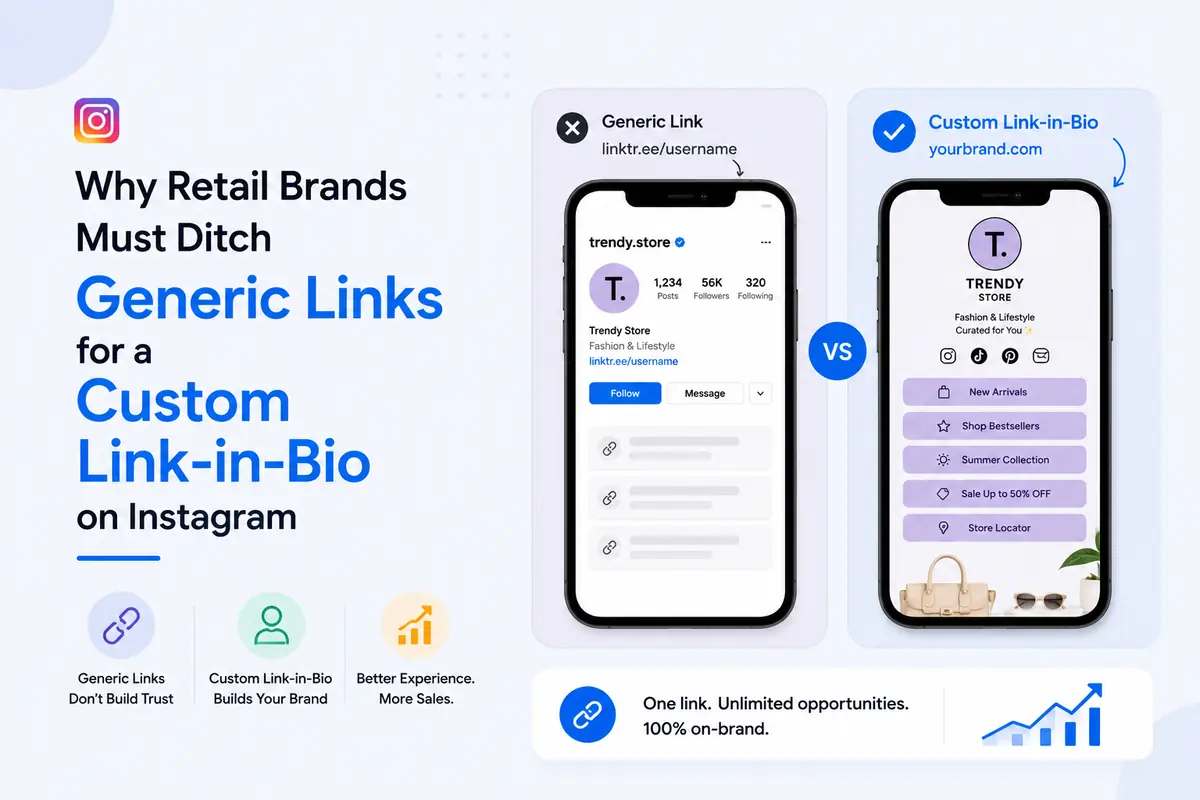
Why Retail Brands Must Ditch Generic Links for a Custom Link-in-Bio on Instagram

· 9 min read
SimpleURL Team
Product & Engineering

A generic link in your Instagram bio sends every follower to the same static page, no matter what post, Reel, or drop brought them there, which means most of your catalog never gets seen.

A custom link in bio for Instagram fixes this by giving each collection, drop, or offer its own trackable, on-brand destination, so the follower who just watched your Reel lands on that exact product instead of your homepage.

TL;DR

  • → One static link = one destination for every follower, regardless of intent
  • → Custom link-in-bio = the right product or drop, in front of the right follower, every time
  • → Generic subdomains read as "free tool." Branded links read as "real brand."
  • → No link-level tracking = no idea which drop, collection, or platform actually sells
  • → Retail catalogs need structure (collections, drops, seasons), not a flat list of buttons

A single generic link quietly buries most of what you sell, because it can only point to one place at a time.

  • Your Reel this week features a new arrival. Your bio link still points to last month's sale.
  • A follower has to leave Instagram, land on your full homepage, and search for the exact item they just saw.
  • Most don't. They close the tab.

That's the whole friction problem, in one sentence.

  • A follower who taps linktr.ee/yourbrand sees a stranger's tool before they see your brand.
  • For a retail brand trying to look premium, established, or trustworthy enough to hand over a card number, that's the wrong first impression at exactly the wrong moment.

Without per-link data, you cannot tell whether last week's Reel drove browsing, add-to-carts, or nothing at all. Instagram's own shopping data shows brands that tag and structure products for discovery see meaningfully higher engagement than those relying on a flat link. A generic bio link gives you none of that visibility.


  • For a retail catalog, the real difference isn't features on a spec sheet, it's whether the page can represent a collection instead of a link list.
  • A single generic link has one destination. A basic link-in-bio tool gives you a stack of buttons. A custom, retail-structured link-in-bio gives you a shoppable hub organized the way your store actually is, by drop, by collection, by season.

Pro tip: if you want the full side-by-side on Linktree, Later, Beacons, and SimpleURL feature by feature, we've already broken that down in Link in Bio vs. Linktree vs. SimpleURL. This piece is about what changes specifically once you're routing a product catalog, not a general tool comparison.


A custom link-in-bio converts better because it removes the extra searching between "I saw it" and "I bought it."

Routing followers straight to the exact drop or collection

Instead of one link for everything, you point each caption or Story to a specific section of your page, or a specific product link entirely. The follower who saw the drop in your Reel lands on the drop, not your full catalog.

On-brand pages that mirror your storefront

  • Wait, isn't Linktree free and good enough for my brand? For a hobby account, sure.
  • For a retail brand asking someone to trust you with a purchase, a page that carries someone else's branding and layout constraints works against you.
  • Your bio link should look like an extension of your storefront, same colors, same logo, same visual language, not a borrowed template.

Fewer taps between "I want that" and checkout

Every extra tap between desire and purchase loses a percentage of buyers. A page structured around your current drop removes taps instead of adding them.


A retail link-in-bio page needs structure a creator's page never has to think about, because you're routing a catalog, not a handful of links.

  • A featured drop or new arrivals slot, above the fold. Whatever you're pushing this week gets the top spot, full stop.
  • Catalog structure grouped by collection, not one long flat list of every SKU you've ever sold.
  • Visual consistency with your storefront, colors, logo, and product imagery that match, so the jump from Instagram to bio page to store feels seamless.
  • A path back to your full store and current offers, for the follower who wants to browse beyond the featured item.

Pro tip: swap your featured drop the same day it changes on your actual store. A bio link showing a sold-out item is worse than no bio link at all.

For layout mechanics like button hierarchy and mobile thumb-zone sizing, our design strategies guide covers that in depth. This is about what goes on the page for a catalog, not how the buttons are styled.


This takes under 15 minutes once your catalog links are ready.

  1. Map your current drops and collections. List what you want followers to reach this month, new arrivals, best sellers, a seasonal sale, your full store.
  2. Build your page in SimpleURL's Link-in-Bio tool. Add your logo, brand colors, and one link per collection or drop.
  3. Connect a branded domain and UTM tracking through Branded Domains and the UTM Builder, so every click is attributed to the post or platform that sent it.
  4. Update it around every launch. When the drop changes, the page changes, same day.

For the exact click-by-click walkthrough and platform-by-platform bio setup, our complete link-in-bio guide covers that step by step.


You prove ROI by tracking clicks per collection, not just total taps on your bio link.

  • Which drop gets clicked, so you know what to restock or promote further
  • Which platform sends buyers, Instagram Reels vs. Stories vs. feed posts, using UTM tags on each
  • How click volume compares to actual add-to-carts, since Instagram's average shopping checkout conversion sits in the low single digits, meaning most of your job is getting the right follower to the right product, not assuming everyone who clicks will buy

Check the short link analytics dashboard weekly. If a collection link is dead, replace it before it wastes another week of traffic.


Fashion and apparel

Lead with the current drop or new arrivals. Group secondary links by category (tops, bottoms, accessories) rather than by product name, since browsing behavior in fashion is category-first.

Beauty and skincare

Feature a hero product or routine bundle up top, with a secondary link to a quiz or routine builder if you have one. Beauty buyers respond well to "shop the routine" framing over a flat product grid.

Home, lifestyle, and accessories

Lead with a seasonal collection (new arrivals, gifting, a seasonal refresh) since home purchases are more occasion-driven than habitual. A secondary link to a "shop by room" or "shop by category" grouping helps browsers self-select.


  • Listing the entire catalog with no hierarchy. If every product has equal visual weight, nothing stands out and browsers leave without clicking anything.
  • Forgetting to swap the featured item after a drop sells out. Nothing kills trust faster than a follower clicking through to a "sold out" page for something you promoted an hour ago.
  • No tracking, so no idea what's actually selling. Without per-link data, you're deciding next week's content based on guesses, not on what your own traffic already told you.

Frequently Asked Questions

A page organized around your current drops or collections, with a branded domain and click tracking on each link, works best for retail specifically. General "best tool" rankings matter less than whether the tool can structure a catalog, not just list links.

For serious catalog and campaign tracking, yes. Linktree's free tier works for a simple link list, but retail brands need branded domains and per-product analytics that free tiers typically don't include.

Yes, if your link-in-bio tool supports per-link analytics. Each collection or product link should show its own click count, device type, and traffic source, not just one combined total for the whole page.

Use the same logo, brand colors, and product photography as your actual store, and connect a branded domain instead of a generic subdomain. Visual consistency is what makes the jump from Instagram feel seamless rather than jarring.

It helps by shortening the path between discovery and purchase. Instagram already drives significant product discovery, and a link-in-bio page structured around your current catalog turns that discovery into a shorter, clearer path to checkout instead of a dead end at your homepage.


Stop Sending Every Follower to the Same Dead End

Your catalog changes every week. Your bio link should too.

Build a branded, catalog-structured page with SimpleURL's Link-in-Bio, connect it to your own domain, and track exactly which drop your followers are actually clicking. Get started free and have your first collection live before your next post goes out.

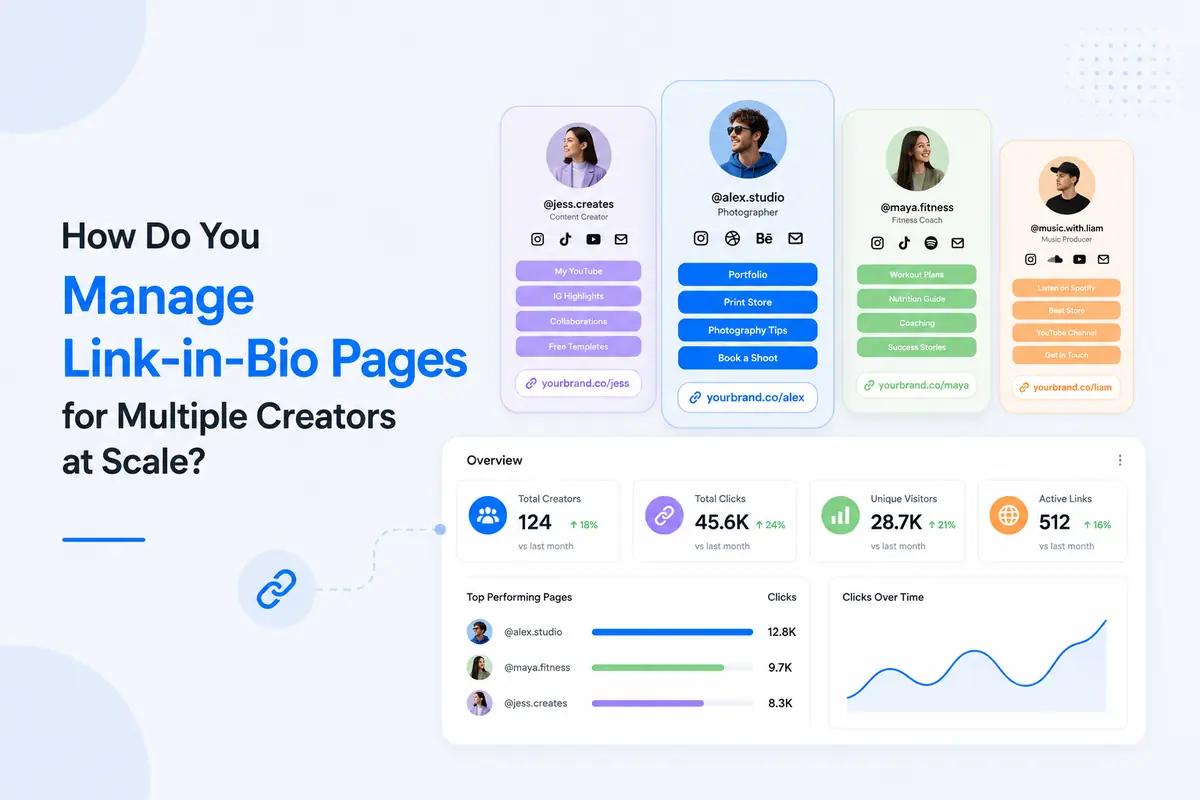
How Do You Manage Link-in-Bio Pages for Multiple Creators at Scale?

· 8 min read
SimpleURL Team
Product & Engineering

You manage link-in-bio pages for multiple creators at scale by centralizing every page in one dashboard, standardizing branded templates across accounts, and tracking performance from a single view instead of logging into a dozen separate tools. That's the entire idea in one sentence. Everything below is the how.

TL;DR

  • Centralize every creator's page in one dashboard instead of managing separate logins one by one
  • Build one branded template and duplicate it, don't redesign from scratch for each creator
  • Standardize naming conventions before you cross 10 pages, not after
  • Track clicks, QR scans, and link performance from a single analytics view
  • Add an approval step so client-facing pages never go live unchecked

Link-in-bio management breaks down the moment you go from one account to ten, because the manual habits that work fine for a single page multiply into real chaos across many.

The Hidden Cost of Manual Workflows

Manual, spreadsheet-based link management costs agencies real hours every week, not just annoyance. Separate logins mean separate passwords, separate update schedules, and separate blind spots.

That dead link sat there for three weeks. Nobody noticed.

Common failure points I've run into:

  • No single view of which pages exist or who owns them
  • Copy-paste errors between creator accounts
  • Expired promotions still live because nobody tracked the end date
  • Performance data scattered across five different logins

Where Brand Consistency Falls Apart

  • Brand consistency falls apart first, because each creator's page usually gets built separately, with different fonts, button shapes, and colors depending on who set it up and when.
  • Twelve creators. Twelve different looks. Not what the client signed up for.
  • I've seen this happen with agencies managing rosters where three creators used one free tool, two used another, and the rest had whatever their previous manager left behind.
  • The client only notices when they screenshot every page for a pitch deck and nothing matches.

I look for four things before recommending any link-in-bio tool for agency-scale work: centralized access, controlled permissions, replicable branding, and consolidated analytics.

1. Centralized Dashboard Over One-Off Logins

One dashboard beats ten logins every time. If I can't see every creator's page from the same screen, I can't manage the account, I can only react to it.

2. Role-Based Access for Teams and Clients

Team members need scoped access, not full account control. Someone editing one client's page shouldn't be able to touch another client's live page by accident.

3. Branded Templates You Can Replicate, Not Rebuild

A template I can duplicate saves hours a design-from-scratch approach never will. → One master template = every new creator page in minutes, not a fresh build every time.

4. Cross-Account Analytics in One View

Reporting from one dashboard beats stitching together five export files. I need link analytics that show every creator's clicks side by side, not five separate CSVs I have to merge manually.

Wait, you might be thinking: can't I just use a free link-in-bio tool for each creator?

Technically, yes. But that's exactly what breaks down at scale. Free, single-account tools mean no shared dashboard, no consolidated reporting, and a login for every single creator you manage.


Managing link-in-bio pages for multiple creators comes down to seven repeatable steps, not a big redesign project.

Step 1: Structure Your Workspace by Client or Creator

Set up your account structure before you build a single page. Group by client, by creator, or by campaign, whichever matches how your team actually reports.

Step 2: Build a Branded Template for Each Client

Design one template per client brand, then reuse it. Match their color palette, button style, and font before you touch an individual creator's page.

Pro tip: Build one master template first, then duplicate it per creator. Editing 12 templates from scratch wastes hours you don't have.

Step 3: Assign Ownership and Access

Decide who owns each page before launch, not after something breaks. Write it down somewhere the whole team can see.

Add your active links, QR codes, and content blocks in the order your audience actually clicks, not the order you happened to create them.

Step 5: Standardize Naming and Tagging

Pick a naming convention on day one and stick to it across every account.

→ Consistent naming = faster audits.

→ No naming system = nobody can find anything by month three.

Step 6: Track Performance From One Dashboard

Check performance across every page from a single view, not one account at a time.

Pro tip: Check analytics weekly, not monthly. A dead link found in week one is a quick fix. Found in week four, it's a client complaint.

Step 7: Update and Swap Content Without Bottlenecks

Build in a process for swapping expired content that doesn't rely on one person remembering to do it.


Best Practices for Managing Bio Pages Across Multiple Creators

1. Personalize Without Breaking Brand Consistency

Personalization should live inside the brand guardrails, not outside them. Let creators adjust their bio, photo, and active links, but lock the template's core structure.

2. Build an Approval Workflow Before Publishing

A quick approval step catches mistakes before a client ever sees them. It doesn't need to be complicated, one internal review before anything goes live is enough.

3. Report Results to Clients Without Extra Work

  • Pull a report straight from your dashboard instead of rebuilding one in a spreadsheet every month. Add UTM tracking to campaign links so attribution is already sitting in the data when you export it.
  • If you're managing branded subdomains per client on top of bio pages, this agency guide to per-client branded domains walks through the setup in more detail.

How SimpleURL Simplifies This for Agencies and Teams

SimpleURL centralizes multi-creator link-in-bio management instead of forcing a separate login per account.

1. One Dashboard, Every Creator's Page

I can search, edit, and update any link-in-bio page from one intuitive dashboard, without touching code for every landing page copy change.

2. On-Brand Customization at Scale

SimpleURL lets you adjust colors, fonts, button shapes, and shadow effects per page while keeping the underlying structure consistent, which is exactly what a multi-creator setup needs.

3. Built-In Analytics and QR Codes

  • Click activity, subscriptions, and sales all show up in one place, and scannable QR codes carry the same central link, so offline and online discovery both funnel into the same data.
  • For anyone weighing SimpleURL against alternatives, this SimpleURL vs Linktree comparison breaks down where each one fits, and the unified toolkit overview covers the full feature set.

  • Picking a different free tool per creator because it's "good enough" for now
  • Skipping naming conventions until you already have 20 unlabeled pages
  • Publishing pages with no approval step
  • Checking analytics only when a client asks first
  • Leaving expired event or promo links live because nobody owns the update

FAQs

A personal page serves one account with one owner. A multi-creator setup needs a shared dashboard, consistent branding across pages, and reporting that spans every account at once.

Yes, with the right platform. Look for centralized access across accounts instead of a separate login for every client or creator you manage.

3. How do agencies keep branding consistent across many creator pages?

By building one branded template per client and duplicating it, rather than designing each creator's page from scratch. Locking the core structure while allowing content-level personalization keeps every page on-brand.

Centralized management, replicable branding, and consolidated analytics matter most. Without these, teams end up managing pages one at a time instead of as a system.

Look for a platform that lets you scope access by client or workspace. That way team members and freelancers only touch the pages relevant to their work.


Try It With Your Own Roster

If you're managing more than a handful of creator or client pages right now, the fastest way to see the difference is to start with a free SimpleURL account and move one client's pages into a single dashboard.

Compare plans on the pricing page, or book a demo if you want to walk through a multi-creator setup with the team first.

Link in Bio vs. Linktree vs. SimpleURL: Which Tool Is Right for You in 2026?

· 5 min read
SimpleURL Team
Product & Engineering

If you've spent more than five minutes on Instagram or TikTok, you've seen the phrase "link in bio." But which link-in-bio tool should you actually use? In this guide we compare the most popular options — Linktree, Later, Beacons, and SimpleURL — so you can make an informed decision.

Social media platforms like Instagram and TikTok only allow one clickable link in your profile. A link-in-bio page solves this by letting you put a single URL in your profile that leads to a beautiful, custom page with multiple links — your latest video, your shop, your newsletter, your podcast episode, and anything else you want people to find.

Instead of constantly swapping out your one link, you point your profile to your link-in-bio page permanently and update the page contents whenever you need to.

The Main Contenders

Linktree

Linktree is the original and most recognised name in link-in-bio tools. It has over 40 million users and is straightforward to set up.

Strengths:

  • Very easy to get started — a page is live in under five minutes
  • Large library of integrations (Shopify, Mailchimp, etc.)
  • Free tier is genuinely functional

Weaknesses:

  • Free tier displays Linktree branding prominently
  • Limited design customisation on free and starter plans
  • No built-in short link or QR code tools — you need separate services for those
  • Analytics are basic on lower tiers
  • Pricing can escalate quickly for teams

Later is primarily a social media scheduling tool that added a link-in-bio feature to its offering.

Strengths:

  • Tightly integrated with Instagram post scheduling
  • Visual grid layout that maps directly to your Instagram feed

Weaknesses:

  • Designed for Instagram specifically — less useful if you're on TikTok or LinkedIn
  • Expensive if you only want the link-in-bio feature and not the full scheduling suite
  • Limited standalone value for creators not already using Later for scheduling

Beacons

Beacons is a newer entrant popular with TikTok creators and focuses heavily on monetisation features like tipping, paid content, and store functionality.

Strengths:

  • Strong monetisation tools built in
  • Good for creators who want to sell directly from their bio page

Weaknesses:

  • Higher learning curve
  • Monetisation features are overkill for businesses that just want to share links
  • Limited short link and analytics integration

SimpleURL

SimpleURL is the only tool in this comparison that combines a link-in-bio page with a full URL shortener, QR code generator, and branded domain support — all in one platform.

Strengths:

  • One platform for links, QR codes, link-in-bio, and analytics
  • Branded short links on your own domain (e.g., go.yourbrand.com/sale)
  • Full click analytics including location, device, and referrer
  • No third-party branding on your link-in-bio page even on lower tiers
  • QR codes auto-generated from your short links — ready for print campaigns
  • Link-in-bio page and short links share the same analytics dashboard

Weaknesses:

  • Fewer pre-built monetisation tools than Beacons
  • Less name recognition than Linktree

Feature Comparison

FeatureLinktree FreeLinktree ProBeaconsSimpleURL
Custom link-in-bio page
Remove brandingPartial
Custom domain✅ (add-on)
Built-in URL shortener
QR code generator
Click analyticsBasicFullBasicFull
Branded short links
Monetisation tools

Who Should Use Which Tool?

Use Linktree if: You want the simplest possible setup and the Linktree name gives you social proof with your audience. It's the safest default for someone who just needs "something" in their bio today.

Use Later if: You're already a Later subscriber for Instagram scheduling and want your link-in-bio integrated with your content calendar.

Use Beacons if: You're a creator whose primary goal is monetisation — selling content, taking tips, or running a digital storefront directly from your bio.

Use SimpleURL if: You want one platform that handles your short links, QR codes, and link-in-bio together with real analytics — and you want your brand name on every link, not someone else's. It's the best choice for small businesses, marketers, and creators who also run offline campaigns or need trackable links across multiple channels.

The Hidden Cost of Using Multiple Tools

The most overlooked factor in this decision is tool sprawl. If you use Linktree for your bio page, Bitly for short links, and a separate QR code generator for print materials — you're paying three subscriptions and checking three dashboards.

SimpleURL consolidates all three into one platform. For businesses running integrated campaigns (online + offline + social), having unified analytics across every link type is worth more than any individual feature comparison.

  1. Sign up at SimpleURL.com
  2. Go to Link in Bio in your dashboard and click Create Page
  3. Add your links, choose your layout, and upload your profile photo
  4. Copy your SimpleURL link-in-bio URL and paste it into your Instagram, TikTok, or Twitter bio

Your page is live instantly. Every click is tracked in your dashboard alongside your short link and QR code analytics.

Create your free link-in-bio page →

What Is a Link in Bio? The Complete 2026 Guide for Creators and Brands

· 13 min read
SimpleURL Team
Product & Engineering

A link in bio is a single webpage that holds multiple links and is placed in a social media profile's bio section. Because most social platforms limit profiles to one clickable link, creators and brands use a link-in-bio page to turn that single slot into a gateway to their entire online presence — their store, newsletter, latest content, booking page, and other social profiles.

If you have ever seen "link in bio" mentioned in an Instagram caption or TikTok video description, this is what that phrase refers to.

5 Link-in-Bio Design Strategies to Maximize Your Creator Revenue in 2026

· 12 min read
SimpleURL Team
Product & Engineering

Your link-in-bio page is the most valuable real estate on your social profile. It is the only clickable destination your Instagram, TikTok, or YouTube followers ever see. Yet most creators treat it like a dumping ground for every link they own.

The difference between a link-in-bio that earns money and one that leaks traffic comes down to five design decisions. This guide covers each one in practical, actionable detail.